1 PENNEY INTERMEDIATE HOLDINGS LLC Consolidated Financial Statements Years ended January 31, 2026 and February 1, 2025 (With Independent Auditors’ Report Thereon)
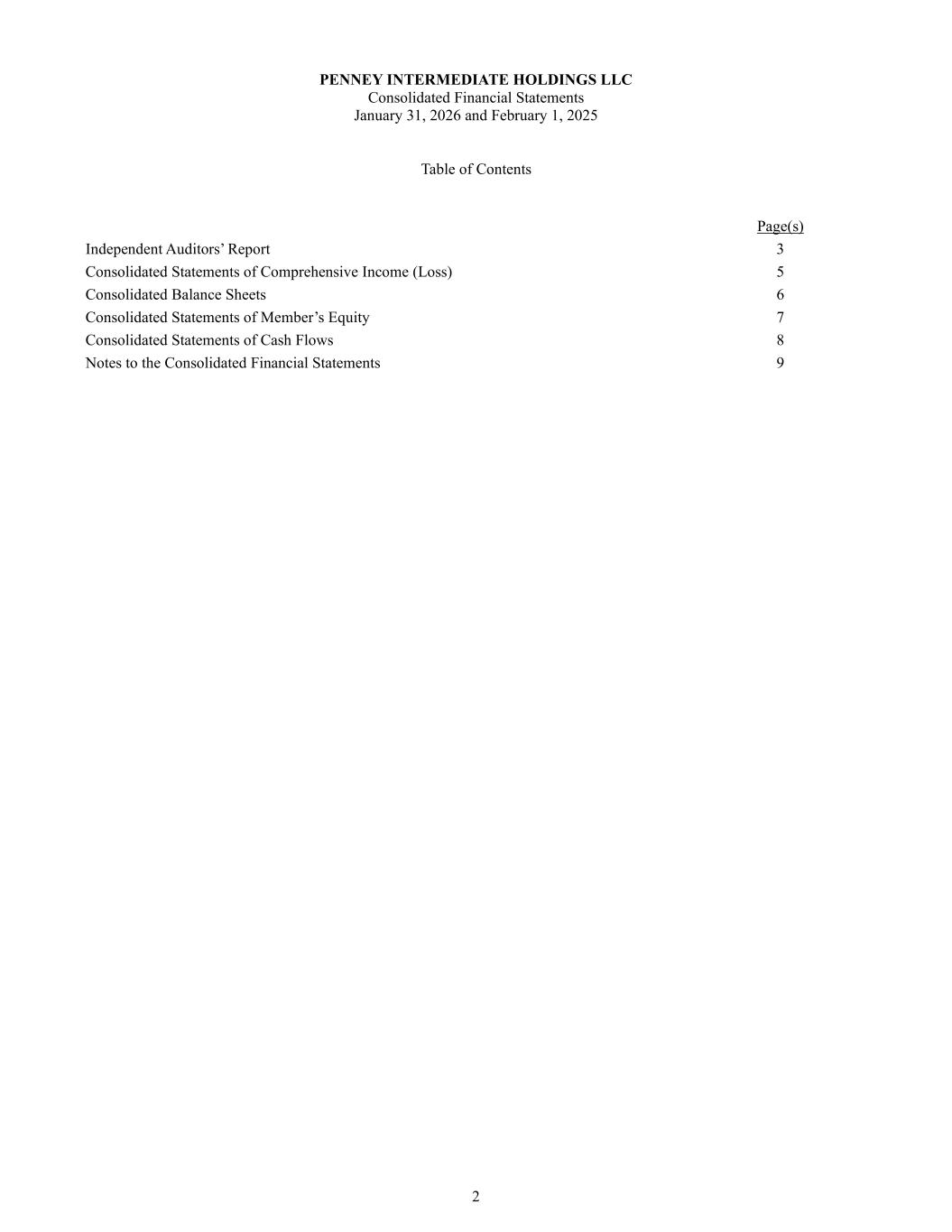
2 PENNEY INTERMEDIATE HOLDINGS LLC Consolidated Financial Statements January 31, 2026 and February 1, 2025 Table of Contents Page(s) Independent Auditors’ Report 3 Consolidated Statements of Comprehensive Income (Loss) 5 Consolidated Balance Sheets 6 Consolidated Statements of Member’s Equity 7 Consolidated Statements of Cash Flows 8 Notes to the Consolidated Financial Statements 9
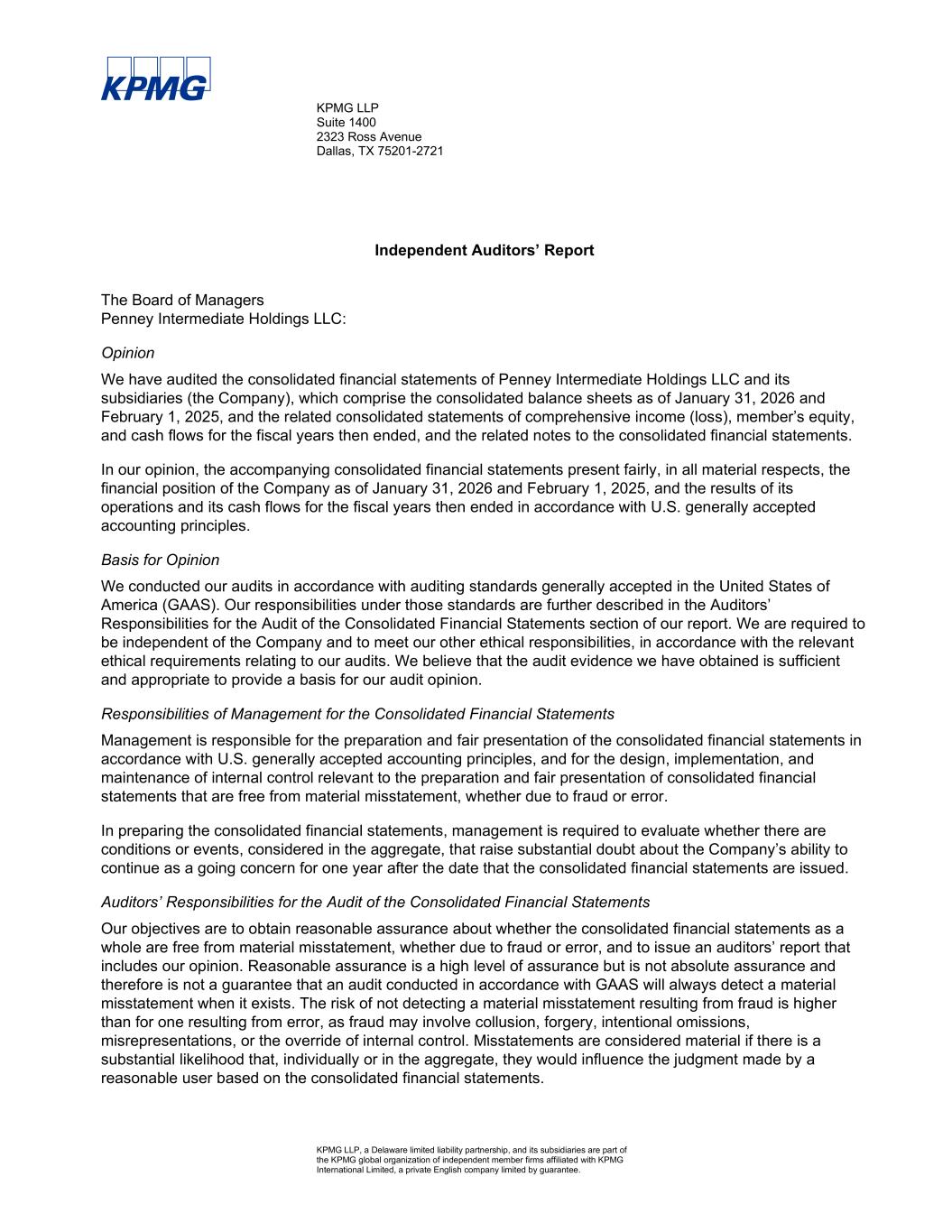
KPMG LLP Suite 1400 2323 Ross Avenue Dallas, TX 75201-2721 KPMG LLP, a Delaware limited liability partnership, and its subsidiaries are part of the KPMG global organization of independent member firms affiliated with KPMG International Limited, a private English company limited by guarantee. Independent Auditors’ Report The Board of Managers Penney Intermediate Holdings LLC: Opinion We have audited the consolidated financial statements of Penney Intermediate Holdings LLC and its subsidiaries (the Company), which comprise the consolidated balance sheets as of January 31, 2026 and February 1, 2025, and the related consolidated statements of comprehensive income (loss), member’s equity, and cash flows for the fiscal years then ended, and the related notes to the consolidated financial statements. In our opinion, the accompanying consolidated financial statements present fairly, in all material respects, the financial position of the Company as of January 31, 2026 and February 1, 2025, and the results of its operations and its cash flows for the fiscal years then ended in accordance with U.S. generally accepted accounting principles. Basis for Opinion We conducted our audits in accordance with auditing standards generally accepted in the United States of America (GAAS). Our responsibilities under those standards are further described in the Auditors’ Responsibilities for the Audit of the Consolidated Financial Statements section of our report. We are required to be independent of the Company and to meet our other ethical responsibilities, in accordance with the relevant ethical requirements relating to our audits. We believe that the audit evidence we have obtained is sufficient and appropriate to provide a basis for our audit opinion. Responsibilities of Management for the Consolidated Financial Statements Management is responsible for the preparation and fair presentation of the consolidated financial statements in accordance with U.S. generally accepted accounting principles, and for the design, implementation, and maintenance of internal control relevant to the preparation and fair presentation of consolidated financial statements that are free from material misstatement, whether due to fraud or error. In preparing the consolidated financial statements, management is required to evaluate whether there are conditions or events, considered in the aggregate, that raise substantial doubt about the Company’s ability to continue as a going concern for one year after the date that the consolidated financial statements are issued. Auditors’ Responsibilities for the Audit of the Consolidated Financial Statements Our objectives are to obtain reasonable assurance about whether the consolidated financial statements as a whole are free from material misstatement, whether due to fraud or error, and to issue an auditors’ report that includes our opinion. Reasonable assurance is a high level of assurance but is not absolute assurance and therefore is not a guarantee that an audit conducted in accordance with GAAS will always detect a material misstatement when it exists. The risk of not detecting a material misstatement resulting from fraud is higher than for one resulting from error, as fraud may involve collusion, forgery, intentional omissions, misrepresentations, or the override of internal control. Misstatements are considered material if there is a substantial likelihood that, individually or in the aggregate, they would influence the judgment made by a reasonable user based on the consolidated financial statements.
4 In performing an audit in accordance with GAAS, we: ● Exercise professional judgment and maintain professional skepticism throughout the audit. ● Identify and assess the risks of material misstatement of the consolidated financial statements, whether due to fraud or error, and design and perform audit procedures responsive to those risks. Such procedures include examining, on a test basis, evidence regarding the amounts and disclosures in the consolidated financial statements. ● Obtain an understanding of internal control relevant to the audit in order to design audit procedures that are appropriate in the circumstances, but not for the purpose of expressing an opinion on the effectiveness of the Company’s internal control. Accordingly, no such opinion is expressed. ● Evaluate the appropriateness of accounting policies used and the reasonableness of significant accounting estimates made by management, as well as evaluate the overall presentation of the consolidated financial statements. ● Conclude whether, in our judgment, there are conditions or events, considered in the aggregate, that raise substantial doubt about the Company’s ability to continue as a going concern for a reasonable period of time. We are required to communicate with those charged with governance regarding, among other matters, the planned scope and timing of the audit, significant audit findings, and certain internal control related matters that we identified during the audit. Dallas, Texas April 23, 2026
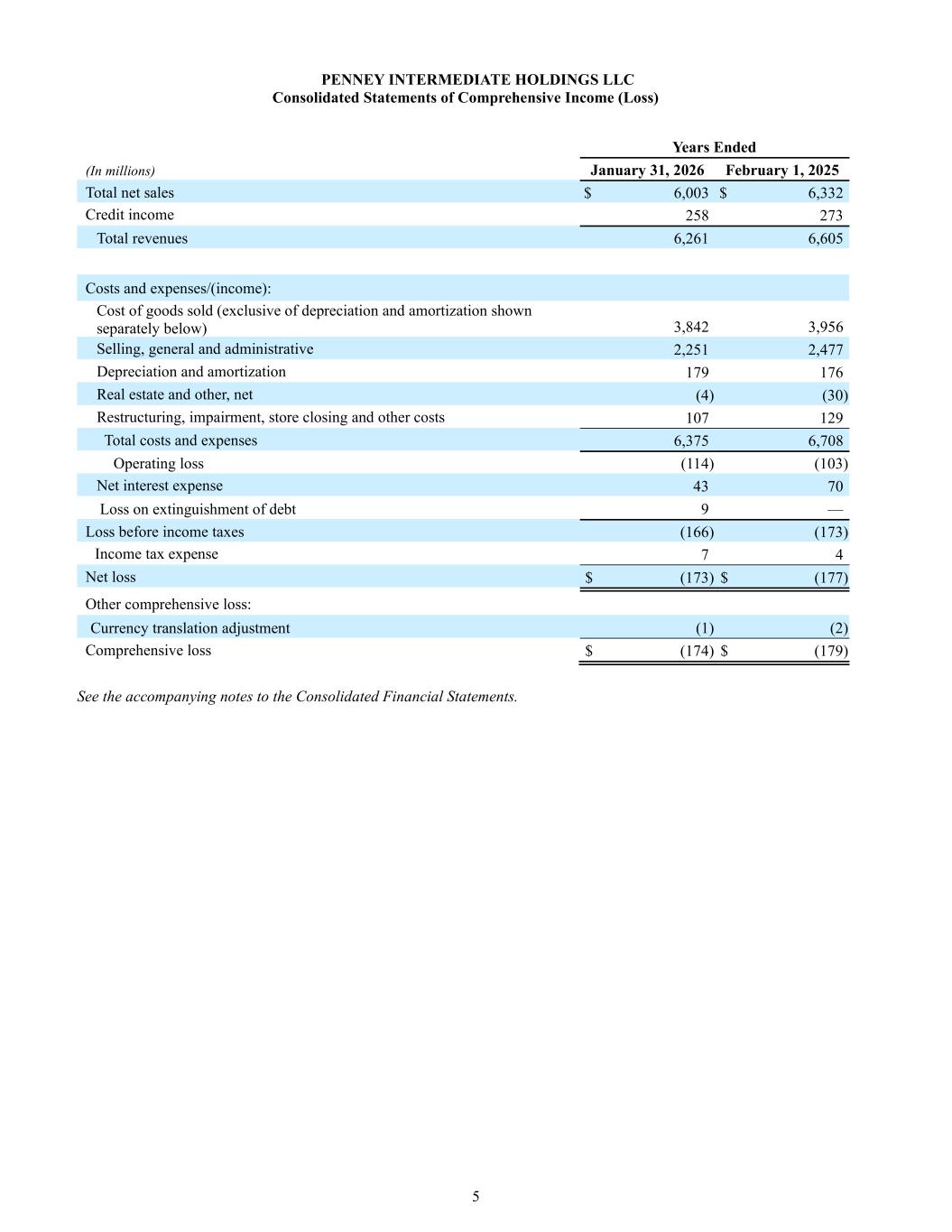
5 PENNEY INTERMEDIATE HOLDINGS LLC Consolidated Statements of Comprehensive Income (Loss) Years Ended (In millions) January 31, 2026 February 1, 2025 Total net sales $ 6,003 $ 6,332 Credit income 258 273 Total revenues 6,261 6,605 Costs and expenses/(income): Cost of goods sold (exclusive of depreciation and amortization shown separately below) 3,842 3,956 Selling, general and administrative 2,251 2,477 Depreciation and amortization 179 176 Real estate and other, net (4) (30) Restructuring, impairment, store closing and other costs 107 129 Total costs and expenses 6,375 6,708 Operating loss (114) (103) Net interest expense 43 70 Loss on extinguishment of debt 9 — Loss before income taxes (166) (173) Income tax expense 7 4 Net loss $ (173) $ (177) Other comprehensive loss: Currency translation adjustment (1) (2) Comprehensive loss $ (174) $ (179) See the accompanying notes to the Consolidated Financial Statements.
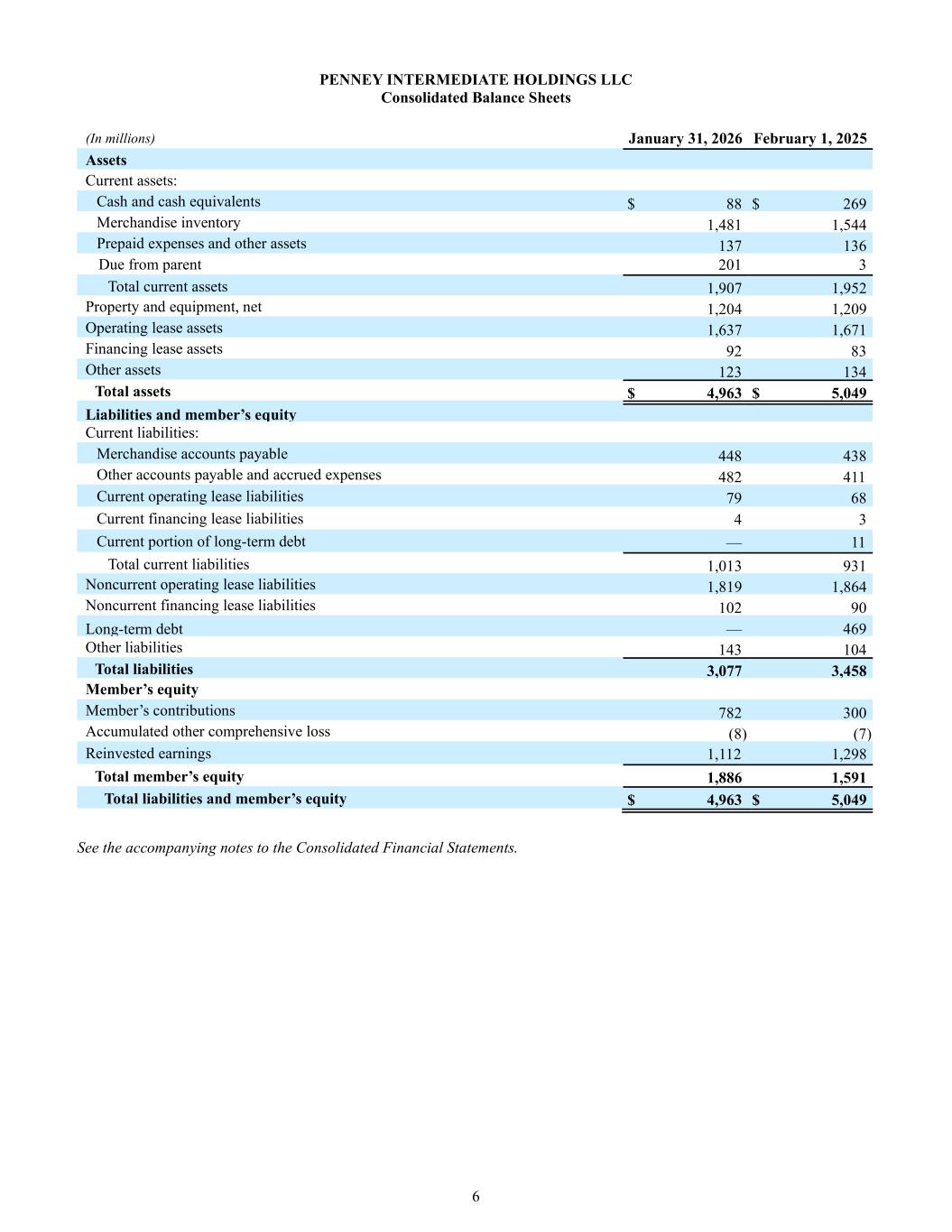
6 PENNEY INTERMEDIATE HOLDINGS LLC Consolidated Balance Sheets (In millions) January 31, 2026 February 1, 2025 Assets Current assets: Cash and cash equivalents $ 88 $ 269 Merchandise inventory 1,481 1,544 Prepaid expenses and other assets 137 136 Due from parent 201 3 Total current assets 1,907 1,952 Property and equipment, net 1,204 1,209 Operating lease assets 1,637 1,671 Financing lease assets 92 83 Other assets 123 134 Total assets $ 4,963 $ 5,049 Liabilities and member’s equity Current liabilities: Merchandise accounts payable 448 438 Other accounts payable and accrued expenses 482 411 Current operating lease liabilities 79 68 Current financing lease liabilities 4 3 Current portion of long-term debt — 11 Total current liabilities 1,013 931 Noncurrent operating lease liabilities 1,819 1,864 Noncurrent financing lease liabilities 102 90 Long-term debt — 469 Other liabilities 143 104 Total liabilities 3,077 3,458 Member’s equity Member’s contributions 782 300 Accumulated other comprehensive loss (8) (7) Reinvested earnings 1,112 1,298 Total member’s equity 1,886 1,591 Total liabilities and member’s equity $ 4,963 $ 5,049 See the accompanying notes to the Consolidated Financial Statements.
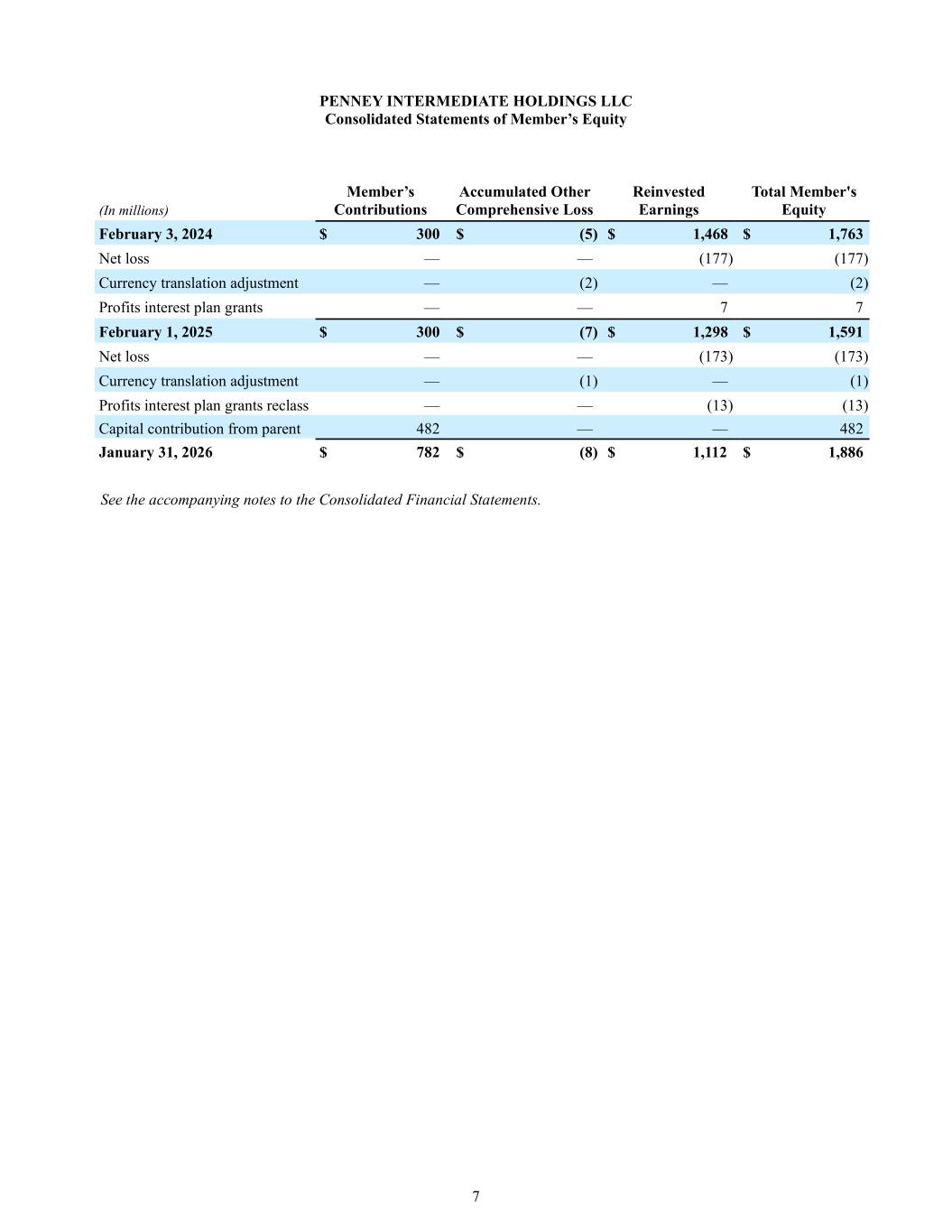
7 PENNEY INTERMEDIATE HOLDINGS LLC Consolidated Statements of Member’s Equity (In millions) Member’s Contributions Accumulated Other Comprehensive Loss Reinvested Earnings Total Member's Equity February 3, 2024 $ 300 $ (5) $ 1,468 $ 1,763 Net loss — — (177) (177) Currency translation adjustment — (2) — (2) Profits interest plan grants — — 7 7 February 1, 2025 $ 300 $ (7) $ 1,298 $ 1,591 Net loss — — (173) (173) Currency translation adjustment — (1) — (1) Profits interest plan grants reclass — — (13) (13) Capital contribution from parent 482 — — 482 January 31, 2026 $ 782 $ (8) $ 1,112 $ 1,886 See the accompanying notes to the Consolidated Financial Statements.
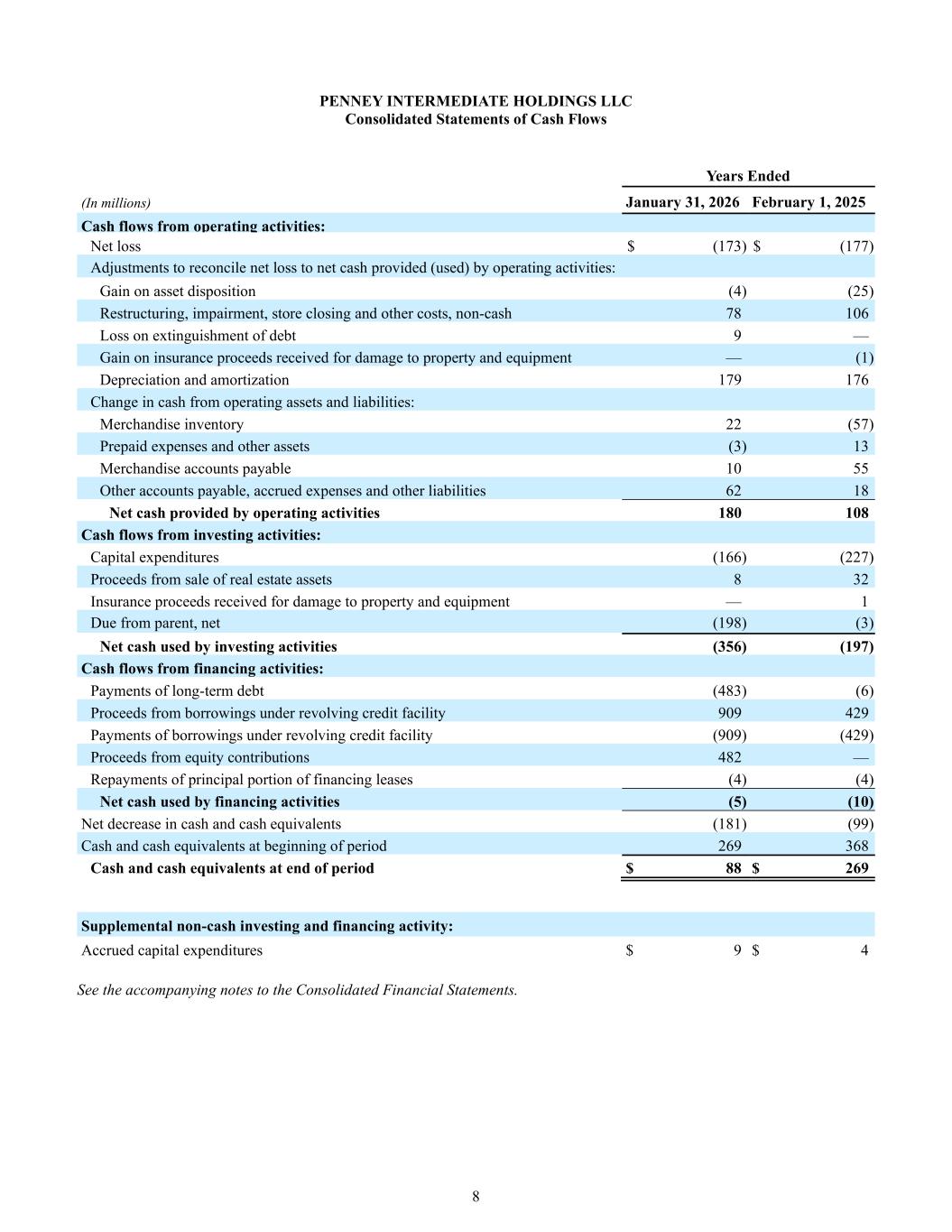
8 PENNEY INTERMEDIATE HOLDINGS LLC Consolidated Statements of Cash Flows Years Ended (In millions) January 31, 2026 February 1, 2025 Cash flows from operating activities: Net loss $ (173) $ (177) Adjustments to reconcile net loss to net cash provided (used) by operating activities: Gain on asset disposition (4) (25) Restructuring, impairment, store closing and other costs, non-cash 78 106 Loss on extinguishment of debt 9 — Gain on insurance proceeds received for damage to property and equipment — (1) Depreciation and amortization 179 176 Change in cash from operating assets and liabilities: Merchandise inventory 22 (57) Prepaid expenses and other assets (3) 13 Merchandise accounts payable 10 55 Other accounts payable, accrued expenses and other liabilities 62 18 Net cash provided by operating activities 180 108 Cash flows from investing activities: Capital expenditures (166) (227) Proceeds from sale of real estate assets 8 32 Insurance proceeds received for damage to property and equipment — 1 Due from parent, net (198) (3) Net cash used by investing activities (356) (197) Cash flows from financing activities: Payments of long-term debt (483) (6) Proceeds from borrowings under revolving credit facility 909 429 Payments of borrowings under revolving credit facility (909) (429) Proceeds from equity contributions 482 — Repayments of principal portion of financing leases (4) (4) Net cash used by financing activities (5) (10) Net decrease in cash and cash equivalents (181) (99) Cash and cash equivalents at beginning of period 269 368 Cash and cash equivalents at end of period $ 88 $ 269 Supplemental non-cash investing and financing activity: Accrued capital expenditures $ 9 $ 4 See the accompanying notes to the Consolidated Financial Statements.
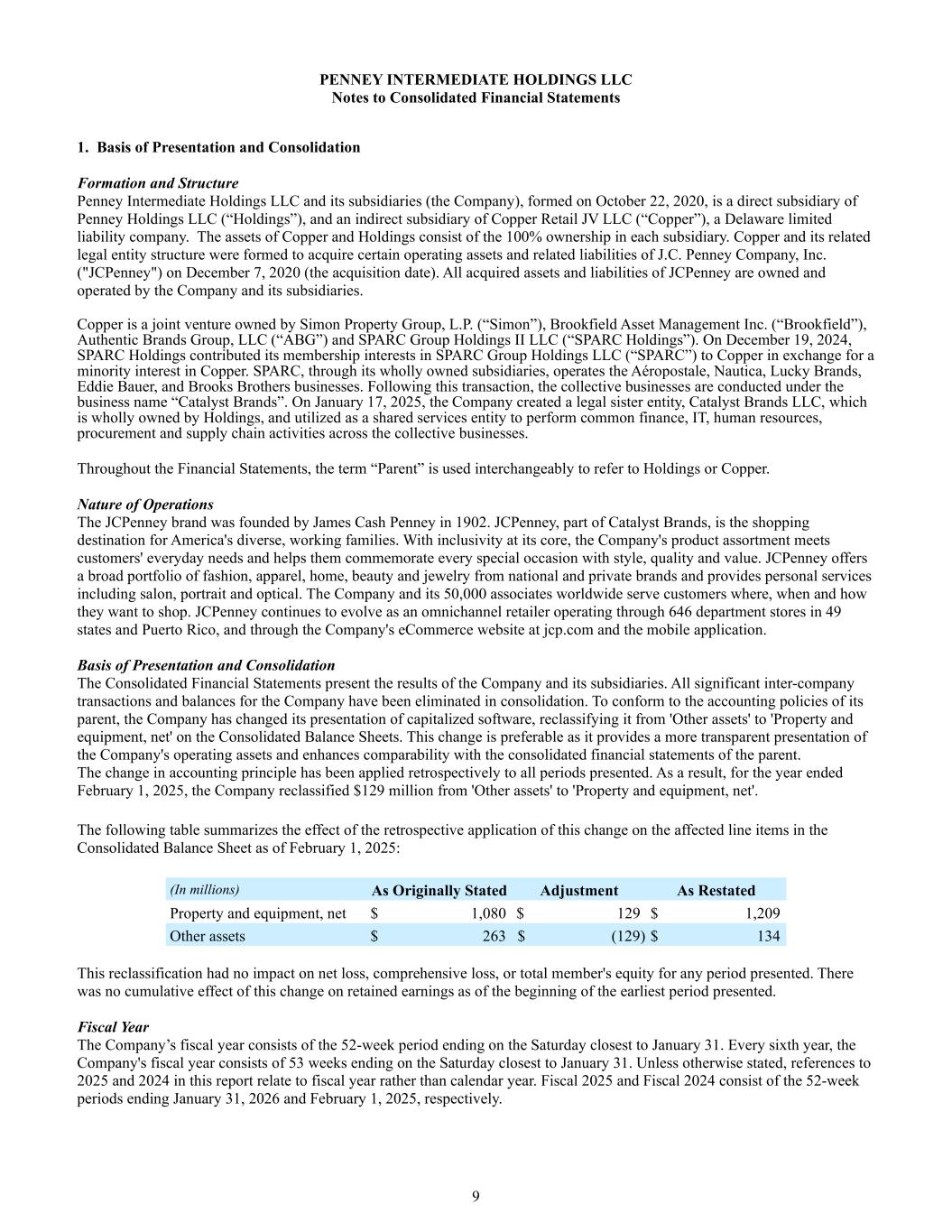
9 PENNEY INTERMEDIATE HOLDINGS LLC Notes to Consolidated Financial Statements 1. Basis of Presentation and Consolidation Formation and Structure Penney Intermediate Holdings LLC and its subsidiaries (the Company), formed on October 22, 2020, is a direct subsidiary of Penney Holdings LLC (“Holdings”), and an indirect subsidiary of Copper Retail JV LLC (“Copper”), a Delaware limited liability company. The assets of Copper and Holdings consist of the 100% ownership in each subsidiary. Copper and its related legal entity structure were formed to acquire certain operating assets and related liabilities of J.C. Penney Company, Inc. ("JCPenney") on December 7, 2020 (the acquisition date). All acquired assets and liabilities of JCPenney are owned and operated by the Company and its subsidiaries. Copper is a joint venture owned by Simon Property Group, L.P. (“Simon”), Brookfield Asset Management Inc. (“Brookfield”), Authentic Brands Group, LLC (“ABG”) and SPARC Group Holdings II LLC (“SPARC Holdings”). On December 19, 2024, SPARC Holdings contributed its membership interests in SPARC Group Holdings LLC (“SPARC”) to Copper in exchange for a minority interest in Copper. SPARC, through its wholly owned subsidiaries, operates the Aéropostale, Nautica, Lucky Brands, Eddie Bauer, and Brooks Brothers businesses. Following this transaction, the collective businesses are conducted under the business name “Catalyst Brands”. On January 17, 2025, the Company created a legal sister entity, Catalyst Brands LLC, which is wholly owned by Holdings, and utilized as a shared services entity to perform common finance, IT, human resources, procurement and supply chain activities across the collective businesses. Throughout the Financial Statements, the term “Parent” is used interchangeably to refer to Holdings or Copper. Nature of Operations The JCPenney brand was founded by James Cash Penney in 1902. JCPenney, part of Catalyst Brands, is the shopping destination for America's diverse, working families. With inclusivity at its core, the Company's product assortment meets customers' everyday needs and helps them commemorate every special occasion with style, quality and value. JCPenney offers a broad portfolio of fashion, apparel, home, beauty and jewelry from national and private brands and provides personal services including salon, portrait and optical. The Company and its 50,000 associates worldwide serve customers where, when and how they want to shop. JCPenney continues to evolve as an omnichannel retailer operating through 646 department stores in 49 states and Puerto Rico, and through the Company's eCommerce website at jcp.com and the mobile application. Basis of Presentation and Consolidation The Consolidated Financial Statements present the results of the Company and its subsidiaries. All significant inter-company transactions and balances for the Company have been eliminated in consolidation. To conform to the accounting policies of its parent, the Company has changed its presentation of capitalized software, reclassifying it from 'Other assets' to 'Property and equipment, net' on the Consolidated Balance Sheets. This change is preferable as it provides a more transparent presentation of the Company's operating assets and enhances comparability with the consolidated financial statements of the parent. The change in accounting principle has been applied retrospectively to all periods presented. As a result, for the year ended February 1, 2025, the Company reclassified $129 million from 'Other assets' to 'Property and equipment, net'. The following table summarizes the effect of the retrospective application of this change on the affected line items in the Consolidated Balance Sheet as of February 1, 2025: (In millions) As Originally Stated Adjustment As Restated Property and equipment, net $ 1,080 $ 129 $ 1,209 Other assets $ 263 $ (129) $ 134 This reclassification had no impact on net loss, comprehensive loss, or total member's equity for any period presented. There was no cumulative effect of this change on retained earnings as of the beginning of the earliest period presented. Fiscal Year The Company’s fiscal year consists of the 52-week period ending on the Saturday closest to January 31. Every sixth year, the Company's fiscal year consists of 53 weeks ending on the Saturday closest to January 31. Unless otherwise stated, references to 2025 and 2024 in this report relate to fiscal year rather than calendar year. Fiscal 2025 and Fiscal 2024 consist of the 52-week periods ending January 31, 2026 and February 1, 2025, respectively.
10 Use of Estimates and Assumptions The preparation of financial statements, in conformity with generally accepted accounting principles in the United States of America, requires the use of assumptions and estimates that affect the reported amounts of assets and liabilities and disclosure of contingent liabilities at the date of the financial statements and the reported amounts of revenues and expenses during the reporting period. Such estimates and assumptions are subject to inherent uncertainties, which may result in actual amounts differing from reported amounts. 2. Significant Accounting Policies Revenue Contracts with customers primarily consist of sales of merchandise and services at the point of sale, sales of gift cards to a customer for a future purchase, customer loyalty rewards that provide discount rewards to customers based on purchase activity, and certain licensing and profit sharing arrangements involving the use of the Company's intellectual property by others. Revenue includes Total net sales and Credit income. Credit income encompasses the revenue earned from the agreement with Synchrony Financial Services Company ("Synchrony") associated with the Company's branded credit card program. Merchandise and Service Sales Total net sales are generally recorded when payment is received and the customer takes control of the merchandise and are reported net of sales tax. Service revenue is recorded at the time the customer receives the benefit of the service, such as salon, portrait and optical. Shipping and handling fees charged to customers are also included in total net sales with corresponding costs recorded as cost of goods sold. Net sales are not recognized for estimated future returns which are estimated based primarily on historical return rates and sales levels. Gift Card Revenue At the time gift cards are sold a performance obligation is created and no revenue is recognized; rather, a contract liability is established for the obligation to provide a merchandise or service sale to the customer for the face value of the card. The contract liability is relieved, and a net sale is recognized when gift cards are redeemed for merchandise or services. The Company recognizes revenue for unredeemed gift cards ("gift card breakage") over the expected redemption period of gift cards. Gift card breakage is estimated based on historical redemption patterns and the estimates can vary based on changes in the usage patterns of customers. Customer Loyalty Rewards Customers who spend a certain amount using the Company's branded credit card or registered loyalty card receive points that accumulate towards earning JCPenney Rewards certificates, which are redeemable for a discount on future purchases. Points earned by a loyalty customer do not expire as long as another purchase is made within the next 12 months, however, any certificates earned expire two months from the date of issuance. The Company accounts for customer loyalty rewards by deferring a portion of sales to loyalty points expected to be earned towards a reward certificate, and then recognizes the reward certificate as revenue when used by the customer in connection with a merchandise or service sale. The points earned toward a future reward are valued at their relative standalone selling price based on historical redemption patterns. Licensing Agreements The Company's branded credit card program is owned and serviced by Synchrony. Under the agreement, periodic cash payments are received from Synchrony based upon the customer's usage of the program’s credit cards and performance of the credit card receivable asset. The Company supports the program by providing marketing promotions designed to increase the use of the card, including enhanced rewards offers for cardholders. Additionally, payments on account are accepted in stores for the convenience of cardholders who prefer to pay in person. Revenue related to this agreement is recognized over the time the Company has fulfilled deliverables and is recorded in Credit income. Principal Versus Agent Principal versus agent considerations are assessed depending on control of the good or service before it is transferred to the customer. When the Company is the principal and has control of the specified good or service, the gross amount of consideration to which the Company expects to be entitled for that specified good or service is recorded as a net sale. In contrast, when the Company is the agent and does not have control of the specified good or service, the fee or commission to which the Company expects to be entitled to for the agency service is recorded as a net sale. In certain instances, the fee or commission might be the net amount retained after paying the supplier. Cost of Goods Sold (Exclusive of Depreciation and Amortization) Cost of goods sold includes costs directly related to bringing merchandise to its final selling destination. These costs include the cost of the merchandise (net of discounts or allowances earned), sourcing and procurement costs, buying and brand development costs, including buyers’ salaries and related expenses, royalties and design fees, freight costs, import duties,
11 warehouse operating expenses, merchandise examination, inspection and testing, store merchandise distribution center expenses, including rent, and shipping and handling costs incurred on eCommerce sales. Vendor Allowances The Company receives vendor support in the form of cash payments or allowances for a variety of reimbursements such as cooperative advertising, markdowns, vendor shipping and packaging compliance, defective merchandise, purchase of vendor specific fixtures and other vendor contributions. Agreements are in place with each vendor setting forth the specific conditions for each allowance or payment. Depending on the arrangement, the Company will either recognize the allowance as a reduction of current costs or defer the payment over the period the related merchandise is sold. If the payment is a reimbursement for costs incurred, it is generally offset against those related costs; otherwise, it is treated as a reduction to the cost of merchandise. Vendor compliance credits are reimbursements for incremental merchandise handling expenses incurred due to a vendor’s failure to comply with established shipping or merchandise preparation requirements. Vendor compliance credits are recorded as a reduction of Cost of goods sold in the Consolidated Statements of Comprehensive Income (Loss). Selling, General and Administrative Expenses (SG&A) SG&A expenses include the following costs, except as related to merchandise buying, sourcing, warehousing, or distribution activities: salaries, marketing costs, occupancy and rent expense, utilities and maintenance, costs related to information technology, administrative costs related to corporate, district and regional operations, real and personal property and other taxes (excluding income taxes) and credit/debit card fees. Advertising Advertising costs, which include, television, internet search marketing, direct mail, radio, and other media advertising, are expensed either as incurred or the first time the advertisement occurs. The Company offsets cooperative advertising allowances against the related advertising expense, which is included in SG&A to the extent it is possible to identify the related cost incurred on a supplier-specific basis. If the allowance exceeds the advertising cost incurred on a supplier specific basis, then the excess allowance is recorded as a reduction of merchandise cost. Total advertising costs, net of cooperative advertising vendor reimbursements, were $359 million in fiscal 2025 and $378 million in fiscal 2024, and were recorded in SG&A. Income Taxes The Company is a single member Limited Liability Company (LLC) and, therefore, a disregarded entity for U.S. federal and state income tax purposes. However, some states impose income type taxes on LLC’s. Accordingly, no federal income tax provision, a limited state income tax provision and a foreign income tax provision have been made in the Company’s financial statements. The Company’s subsidiaries account for their respective legal entity-level state and foreign income tax provision, which is comprised primarily of the entity-level Texas Gross Margin tax and foreign income taxes incurred by its foreign and Puerto Rico subsidiaries. Such income taxes are accounted for using the asset and liability method and the related expense (benefit) is recorded in Income tax expense (benefit) in the Consolidated Statements of Comprehensive Income (Loss). Certain states impose franchise and gross receipts taxes at the entity level. These non-income taxes are accounted for within SG&A in the Consolidated Statements of Comprehensive Income (Loss). Cash and Cash Equivalents Cash and cash equivalents represent cash in banks, short-term investments, and cash in transit, which include credit card sales transactions that are settled early in the following period. Merchandise Inventory Inventories are valued at the lower of cost (using the first-in, first-out or “FIFO” method) or market (using the retail inventory method (RIM)). Under RIM, retail values of merchandise groups are converted to a cost basis by applying the specific average cost-to-retail ratio related to each merchandise grouping. Shrinkage accruals have been estimated as a percent of sales based on historical shrinkage experience. Physical inventory counts for stores are scheduled at least annually and cycle count activities for distribution centers and regional warehouses are executed on a daily basis. Inventory records and shrinkage accruals are adjusted based on the actual results from physical inventories and cycle counts.
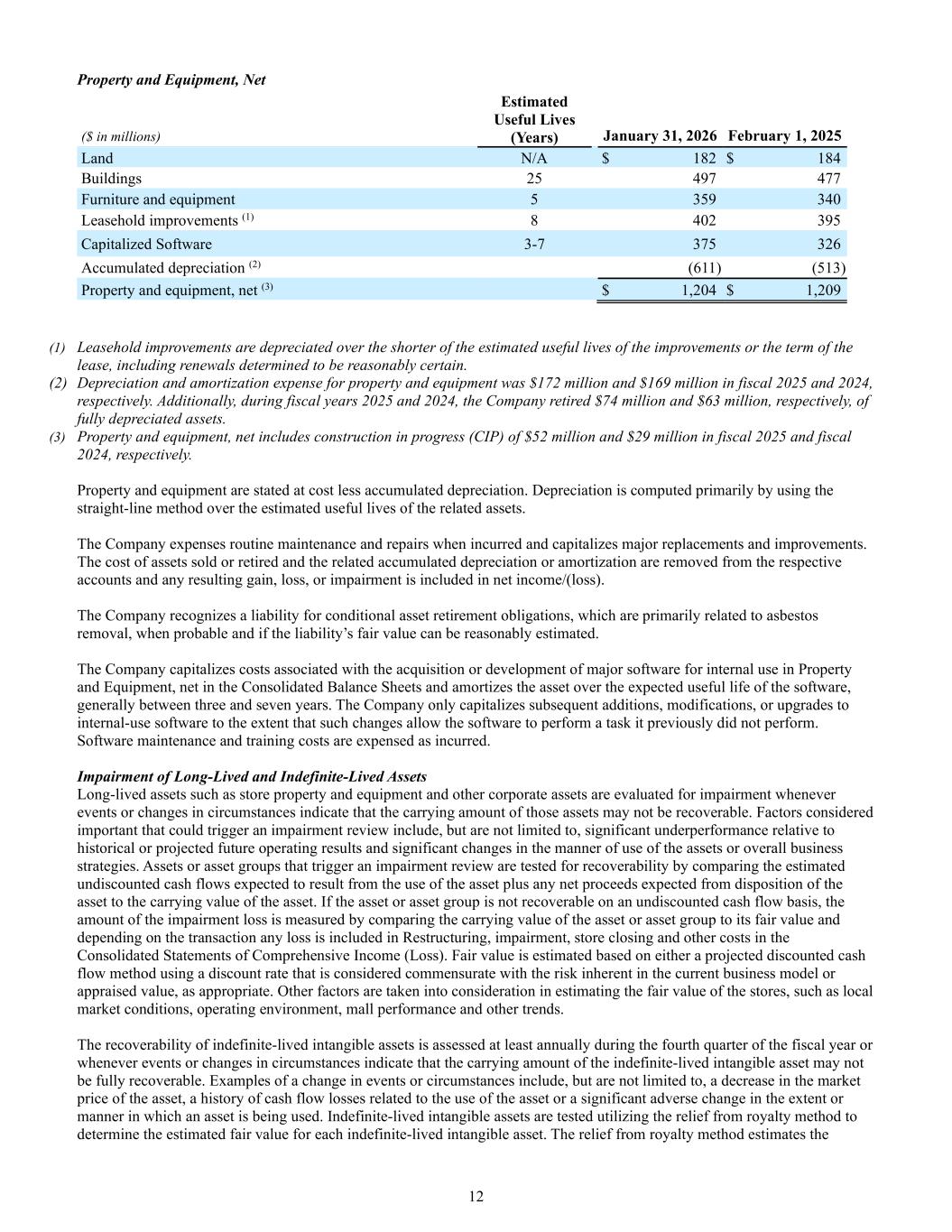
12 Property and Equipment, Net ($ in millions) Estimated Useful Lives (Years) January 31, 2026 February 1, 2025 Land N/A $ 182 $ 184 Buildings 25 497 477 Furniture and equipment 5 359 340 Leasehold improvements (1) 8 402 395 Capitalized Software 3-7 375 326 Accumulated depreciation (2) (611) (513) Property and equipment, net (3) $ 1,204 $ 1,209 (1) Leasehold improvements are depreciated over the shorter of the estimated useful lives of the improvements or the term of the lease, including renewals determined to be reasonably certain. (2) Depreciation and amortization expense for property and equipment was $172 million and $169 million in fiscal 2025 and 2024, respectively. Additionally, during fiscal years 2025 and 2024, the Company retired $74 million and $63 million, respectively, of fully depreciated assets. (3) Property and equipment, net includes construction in progress (CIP) of $52 million and $29 million in fiscal 2025 and fiscal 2024, respectively. Property and equipment are stated at cost less accumulated depreciation. Depreciation is computed primarily by using the straight-line method over the estimated useful lives of the related assets. The Company expenses routine maintenance and repairs when incurred and capitalizes major replacements and improvements. The cost of assets sold or retired and the related accumulated depreciation or amortization are removed from the respective accounts and any resulting gain, loss, or impairment is included in net income/(loss). The Company recognizes a liability for conditional asset retirement obligations, which are primarily related to asbestos removal, when probable and if the liability’s fair value can be reasonably estimated. The Company capitalizes costs associated with the acquisition or development of major software for internal use in Property and Equipment, net in the Consolidated Balance Sheets and amortizes the asset over the expected useful life of the software, generally between three and seven years. The Company only capitalizes subsequent additions, modifications, or upgrades to internal-use software to the extent that such changes allow the software to perform a task it previously did not perform. Software maintenance and training costs are expensed as incurred. Impairment of Long-Lived and Indefinite-Lived Assets Long-lived assets such as store property and equipment and other corporate assets are evaluated for impairment whenever events or changes in circumstances indicate that the carrying amount of those assets may not be recoverable. Factors considered important that could trigger an impairment review include, but are not limited to, significant underperformance relative to historical or projected future operating results and significant changes in the manner of use of the assets or overall business strategies. Assets or asset groups that trigger an impairment review are tested for recoverability by comparing the estimated undiscounted cash flows expected to result from the use of the asset plus any net proceeds expected from disposition of the asset to the carrying value of the asset. If the asset or asset group is not recoverable on an undiscounted cash flow basis, the amount of the impairment loss is measured by comparing the carrying value of the asset or asset group to its fair value and depending on the transaction any loss is included in Restructuring, impairment, store closing and other costs in the Consolidated Statements of Comprehensive Income (Loss). Fair value is estimated based on either a projected discounted cash flow method using a discount rate that is considered commensurate with the risk inherent in the current business model or appraised value, as appropriate. Other factors are taken into consideration in estimating the fair value of the stores, such as local market conditions, operating environment, mall performance and other trends. The recoverability of indefinite-lived intangible assets is assessed at least annually during the fourth quarter of the fiscal year or whenever events or changes in circumstances indicate that the carrying amount of the indefinite-lived intangible asset may not be fully recoverable. Examples of a change in events or circumstances include, but are not limited to, a decrease in the market price of the asset, a history of cash flow losses related to the use of the asset or a significant adverse change in the extent or manner in which an asset is being used. Indefinite-lived intangible assets are tested utilizing the relief from royalty method to determine the estimated fair value for each indefinite-lived intangible asset. The relief from royalty method estimates the
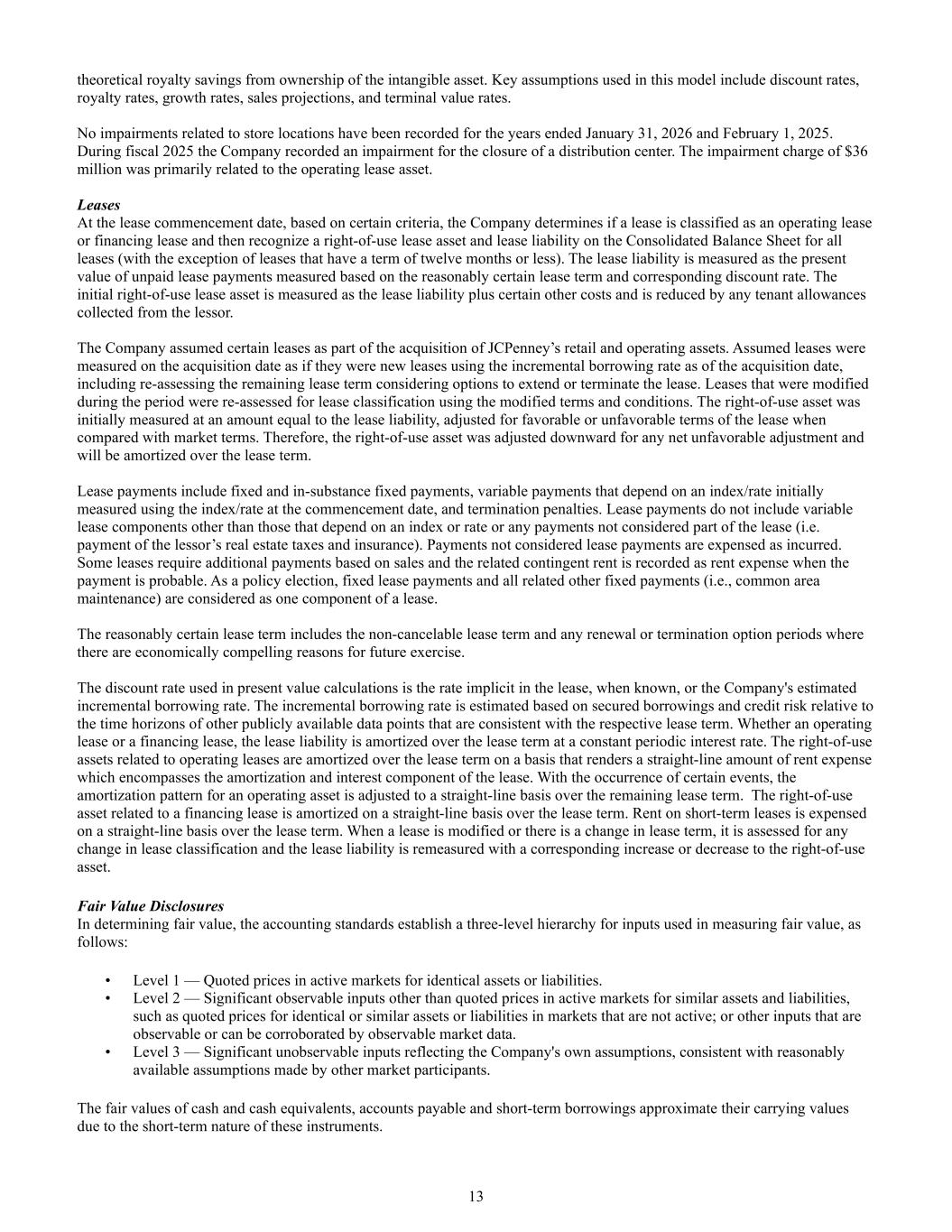
13 theoretical royalty savings from ownership of the intangible asset. Key assumptions used in this model include discount rates, royalty rates, growth rates, sales projections, and terminal value rates. No impairments related to store locations have been recorded for the years ended January 31, 2026 and February 1, 2025. During fiscal 2025 the Company recorded an impairment for the closure of a distribution center. The impairment charge of $36 million was primarily related to the operating lease asset. Leases At the lease commencement date, based on certain criteria, the Company determines if a lease is classified as an operating lease or financing lease and then recognize a right-of-use lease asset and lease liability on the Consolidated Balance Sheet for all leases (with the exception of leases that have a term of twelve months or less). The lease liability is measured as the present value of unpaid lease payments measured based on the reasonably certain lease term and corresponding discount rate. The initial right-of-use lease asset is measured as the lease liability plus certain other costs and is reduced by any tenant allowances collected from the lessor. The Company assumed certain leases as part of the acquisition of JCPenney’s retail and operating assets. Assumed leases were measured on the acquisition date as if they were new leases using the incremental borrowing rate as of the acquisition date, including re-assessing the remaining lease term considering options to extend or terminate the lease. Leases that were modified during the period were re-assessed for lease classification using the modified terms and conditions. The right-of-use asset was initially measured at an amount equal to the lease liability, adjusted for favorable or unfavorable terms of the lease when compared with market terms. Therefore, the right-of-use asset was adjusted downward for any net unfavorable adjustment and will be amortized over the lease term. Lease payments include fixed and in-substance fixed payments, variable payments that depend on an index/rate initially measured using the index/rate at the commencement date, and termination penalties. Lease payments do not include variable lease components other than those that depend on an index or rate or any payments not considered part of the lease (i.e. payment of the lessor’s real estate taxes and insurance). Payments not considered lease payments are expensed as incurred. Some leases require additional payments based on sales and the related contingent rent is recorded as rent expense when the payment is probable. As a policy election, fixed lease payments and all related other fixed payments (i.e., common area maintenance) are considered as one component of a lease. The reasonably certain lease term includes the non-cancelable lease term and any renewal or termination option periods where there are economically compelling reasons for future exercise. The discount rate used in present value calculations is the rate implicit in the lease, when known, or the Company's estimated incremental borrowing rate. The incremental borrowing rate is estimated based on secured borrowings and credit risk relative to the time horizons of other publicly available data points that are consistent with the respective lease term. Whether an operating lease or a financing lease, the lease liability is amortized over the lease term at a constant periodic interest rate. The right-of-use assets related to operating leases are amortized over the lease term on a basis that renders a straight-line amount of rent expense which encompasses the amortization and interest component of the lease. With the occurrence of certain events, the amortization pattern for an operating asset is adjusted to a straight-line basis over the remaining lease term. The right-of-use asset related to a financing lease is amortized on a straight-line basis over the lease term. Rent on short-term leases is expensed on a straight-line basis over the lease term. When a lease is modified or there is a change in lease term, it is assessed for any change in lease classification and the lease liability is remeasured with a corresponding increase or decrease to the right-of-use asset. Fair Value Disclosures In determining fair value, the accounting standards establish a three-level hierarchy for inputs used in measuring fair value, as follows: • Level 1 — Quoted prices in active markets for identical assets or liabilities. • Level 2 — Significant observable inputs other than quoted prices in active markets for similar assets and liabilities, such as quoted prices for identical or similar assets or liabilities in markets that are not active; or other inputs that are observable or can be corroborated by observable market data. • Level 3 — Significant unobservable inputs reflecting the Company's own assumptions, consistent with reasonably available assumptions made by other market participants. The fair values of cash and cash equivalents, accounts payable and short-term borrowings approximate their carrying values due to the short-term nature of these instruments.
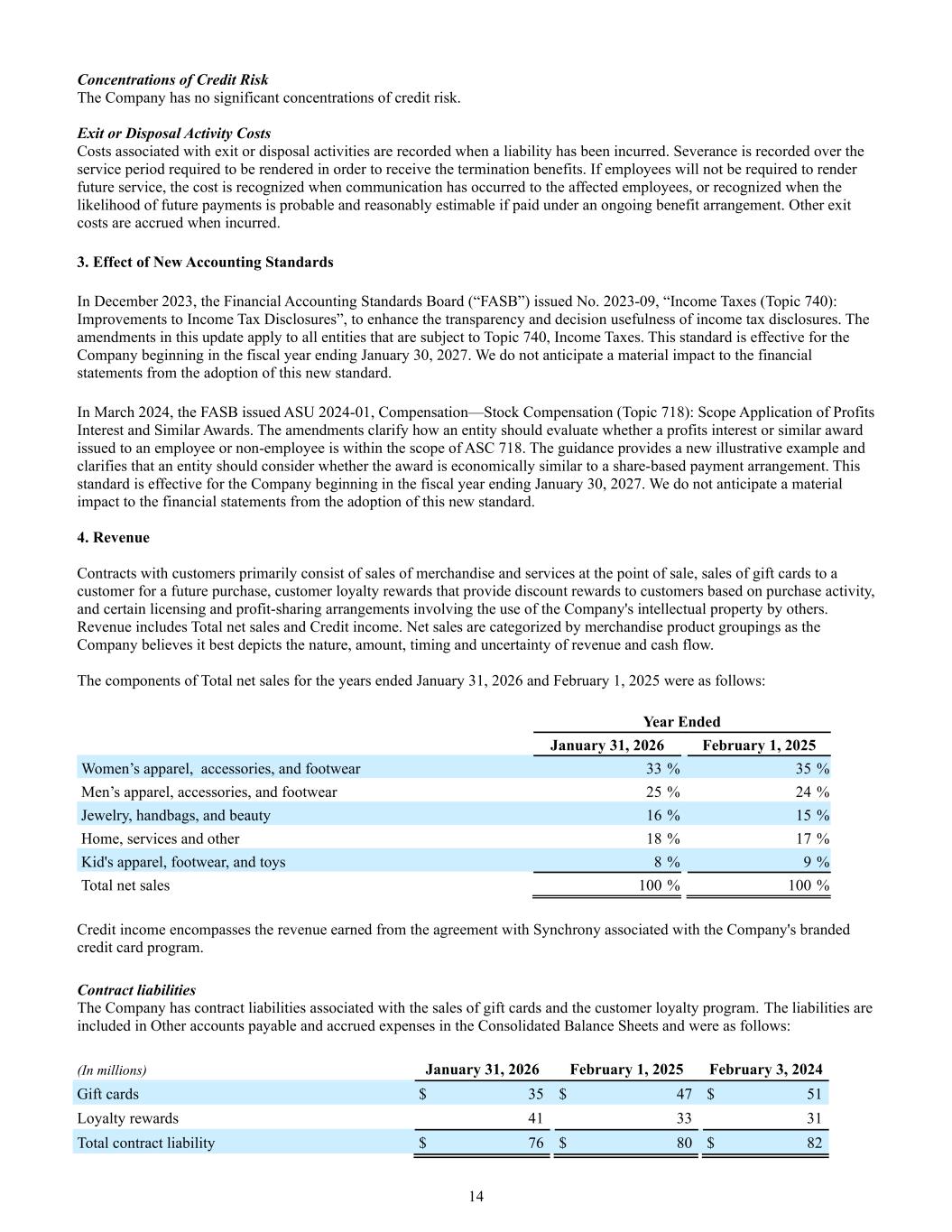
14 Concentrations of Credit Risk The Company has no significant concentrations of credit risk. Exit or Disposal Activity Costs Costs associated with exit or disposal activities are recorded when a liability has been incurred. Severance is recorded over the service period required to be rendered in order to receive the termination benefits. If employees will not be required to render future service, the cost is recognized when communication has occurred to the affected employees, or recognized when the likelihood of future payments is probable and reasonably estimable if paid under an ongoing benefit arrangement. Other exit costs are accrued when incurred. 3. Effect of New Accounting Standards In December 2023, the Financial Accounting Standards Board (“FASB”) issued No. 2023-09, “Income Taxes (Topic 740): Improvements to Income Tax Disclosures”, to enhance the transparency and decision usefulness of income tax disclosures. The amendments in this update apply to all entities that are subject to Topic 740, Income Taxes. This standard is effective for the Company beginning in the fiscal year ending January 30, 2027. We do not anticipate a material impact to the financial statements from the adoption of this new standard. In March 2024, the FASB issued ASU 2024‑01, Compensation—Stock Compensation (Topic 718): Scope Application of Profits Interest and Similar Awards. The amendments clarify how an entity should evaluate whether a profits interest or similar award issued to an employee or non‑employee is within the scope of ASC 718. The guidance provides a new illustrative example and clarifies that an entity should consider whether the award is economically similar to a share‑based payment arrangement. This standard is effective for the Company beginning in the fiscal year ending January 30, 2027. We do not anticipate a material impact to the financial statements from the adoption of this new standard. 4. Revenue Contracts with customers primarily consist of sales of merchandise and services at the point of sale, sales of gift cards to a customer for a future purchase, customer loyalty rewards that provide discount rewards to customers based on purchase activity, and certain licensing and profit-sharing arrangements involving the use of the Company's intellectual property by others. Revenue includes Total net sales and Credit income. Net sales are categorized by merchandise product groupings as the Company believes it best depicts the nature, amount, timing and uncertainty of revenue and cash flow. The components of Total net sales for the years ended January 31, 2026 and February 1, 2025 were as follows: Year Ended January 31, 2026 February 1, 2025 Women’s apparel, accessories, and footwear 33 % 35 % Men’s apparel, accessories, and footwear 25 % 24 % Jewelry, handbags, and beauty 16 % 15 % Home, services and other 18 % 17 % Kid's apparel, footwear, and toys 8 % 9 % Total net sales 100 % 100 % Credit income encompasses the revenue earned from the agreement with Synchrony associated with the Company's branded credit card program. Contract liabilities The Company has contract liabilities associated with the sales of gift cards and the customer loyalty program. The liabilities are included in Other accounts payable and accrued expenses in the Consolidated Balance Sheets and were as follows: (In millions) January 31, 2026 February 1, 2025 February 3, 2024 Gift cards $ 35 $ 47 $ 51 Loyalty rewards 41 33 31 Total contract liability $ 76 $ 80 $ 82
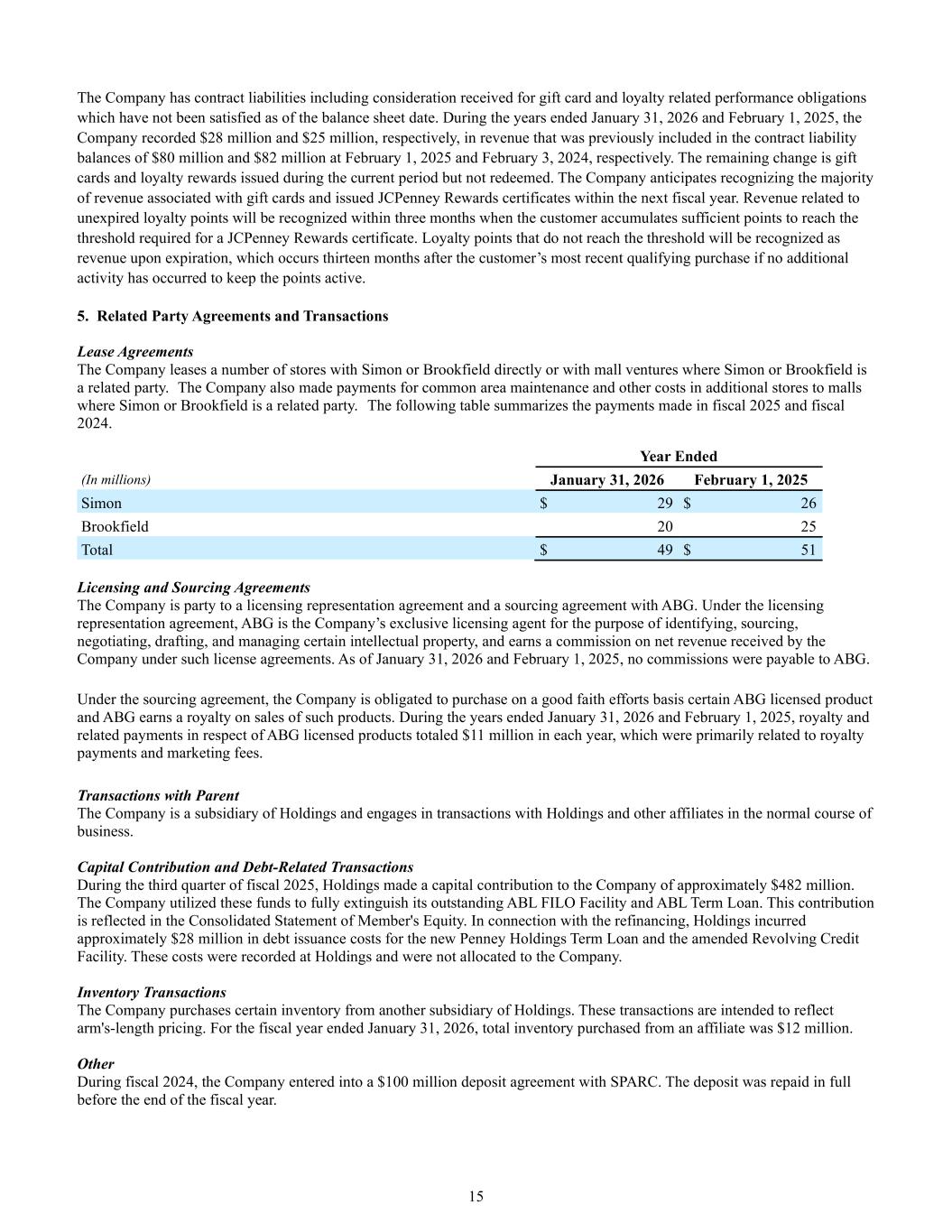
15 The Company has contract liabilities including consideration received for gift card and loyalty related performance obligations which have not been satisfied as of the balance sheet date. During the years ended January 31, 2026 and February 1, 2025, the Company recorded $28 million and $25 million, respectively, in revenue that was previously included in the contract liability balances of $80 million and $82 million at February 1, 2025 and February 3, 2024, respectively. The remaining change is gift cards and loyalty rewards issued during the current period but not redeemed. The Company anticipates recognizing the majority of revenue associated with gift cards and issued JCPenney Rewards certificates within the next fiscal year. Revenue related to unexpired loyalty points will be recognized within three months when the customer accumulates sufficient points to reach the threshold required for a JCPenney Rewards certificate. Loyalty points that do not reach the threshold will be recognized as revenue upon expiration, which occurs thirteen months after the customer’s most recent qualifying purchase if no additional activity has occurred to keep the points active. 5. Related Party Agreements and Transactions Lease Agreements The Company leases a number of stores with Simon or Brookfield directly or with mall ventures where Simon or Brookfield is a related party. The Company also made payments for common area maintenance and other costs in additional stores to malls where Simon or Brookfield is a related party. The following table summarizes the payments made in fiscal 2025 and fiscal 2024. Year Ended (In millions) January 31, 2026 February 1, 2025 Simon $ 29 $ 26 Brookfield 20 25 Total $ 49 $ 51 Licensing and Sourcing Agreements The Company is party to a licensing representation agreement and a sourcing agreement with ABG. Under the licensing representation agreement, ABG is the Company’s exclusive licensing agent for the purpose of identifying, sourcing, negotiating, drafting, and managing certain intellectual property, and earns a commission on net revenue received by the Company under such license agreements. As of January 31, 2026 and February 1, 2025, no commissions were payable to ABG. Under the sourcing agreement, the Company is obligated to purchase on a good faith efforts basis certain ABG licensed product and ABG earns a royalty on sales of such products. During the years ended January 31, 2026 and February 1, 2025, royalty and related payments in respect of ABG licensed products totaled $11 million in each year, which were primarily related to royalty payments and marketing fees. Transactions with Parent The Company is a subsidiary of Holdings and engages in transactions with Holdings and other affiliates in the normal course of business. Capital Contribution and Debt-Related Transactions During the third quarter of fiscal 2025, Holdings made a capital contribution to the Company of approximately $482 million. The Company utilized these funds to fully extinguish its outstanding ABL FILO Facility and ABL Term Loan. This contribution is reflected in the Consolidated Statement of Member's Equity. In connection with the refinancing, Holdings incurred approximately $28 million in debt issuance costs for the new Penney Holdings Term Loan and the amended Revolving Credit Facility. These costs were recorded at Holdings and were not allocated to the Company. Inventory Transactions The Company purchases certain inventory from another subsidiary of Holdings. These transactions are intended to reflect arm's-length pricing. For the fiscal year ended January 31, 2026, total inventory purchased from an affiliate was $12 million. Other During fiscal 2024, the Company entered into a $100 million deposit agreement with SPARC. The deposit was repaid in full before the end of the fiscal year.
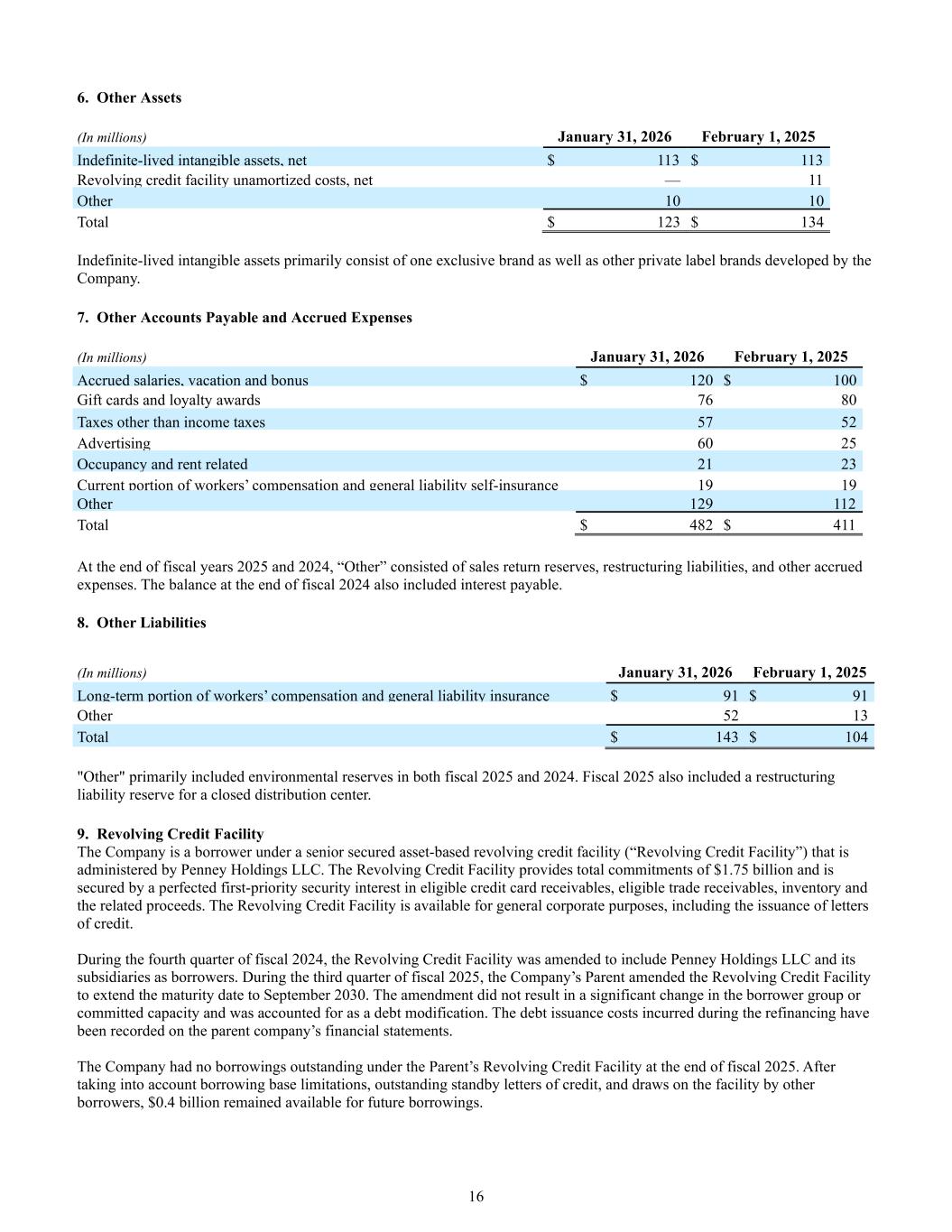
16 6. Other Assets (In millions) January 31, 2026 February 1, 2025 Indefinite-lived intangible assets, net $ 113 $ 113 Revolving credit facility unamortized costs, net — 11 Other 10 10 Total $ 123 $ 134 Indefinite-lived intangible assets primarily consist of one exclusive brand as well as other private label brands developed by the Company. 7. Other Accounts Payable and Accrued Expenses (In millions) January 31, 2026 February 1, 2025 Accrued salaries, vacation and bonus $ 120 $ 100 Gift cards and loyalty awards 76 80 Taxes other than income taxes 57 52 Advertising 60 25 Occupancy and rent related 21 23 Current portion of workers’ compensation and general liability self-insurance 19 19 Other 129 112 Total $ 482 $ 411 At the end of fiscal years 2025 and 2024, “Other” consisted of sales return reserves, restructuring liabilities, and other accrued expenses. The balance at the end of fiscal 2024 also included interest payable. 8. Other Liabilities (In millions) January 31, 2026 February 1, 2025 Long-term portion of workers’ compensation and general liability insurance $ 91 $ 91 Other 52 13 Total $ 143 $ 104 "Other" primarily included environmental reserves in both fiscal 2025 and 2024. Fiscal 2025 also included a restructuring liability reserve for a closed distribution center. 9. Revolving Credit Facility The Company is a borrower under a senior secured asset-based revolving credit facility (“Revolving Credit Facility”) that is administered by Penney Holdings LLC. The Revolving Credit Facility provides total commitments of $1.75 billion and is secured by a perfected first-priority security interest in eligible credit card receivables, eligible trade receivables, inventory and the related proceeds. The Revolving Credit Facility is available for general corporate purposes, including the issuance of letters of credit. During the fourth quarter of fiscal 2024, the Revolving Credit Facility was amended to include Penney Holdings LLC and its subsidiaries as borrowers. During the third quarter of fiscal 2025, the Company’s Parent amended the Revolving Credit Facility to extend the maturity date to September 2030. The amendment did not result in a significant change in the borrower group or committed capacity and was accounted for as a debt modification. The debt issuance costs incurred during the refinancing have been recorded on the parent company’s financial statements. The Company had no borrowings outstanding under the Parent’s Revolving Credit Facility at the end of fiscal 2025. After taking into account borrowing base limitations, outstanding standby letters of credit, and draws on the facility by other borrowers, $0.4 billion remained available for future borrowings.
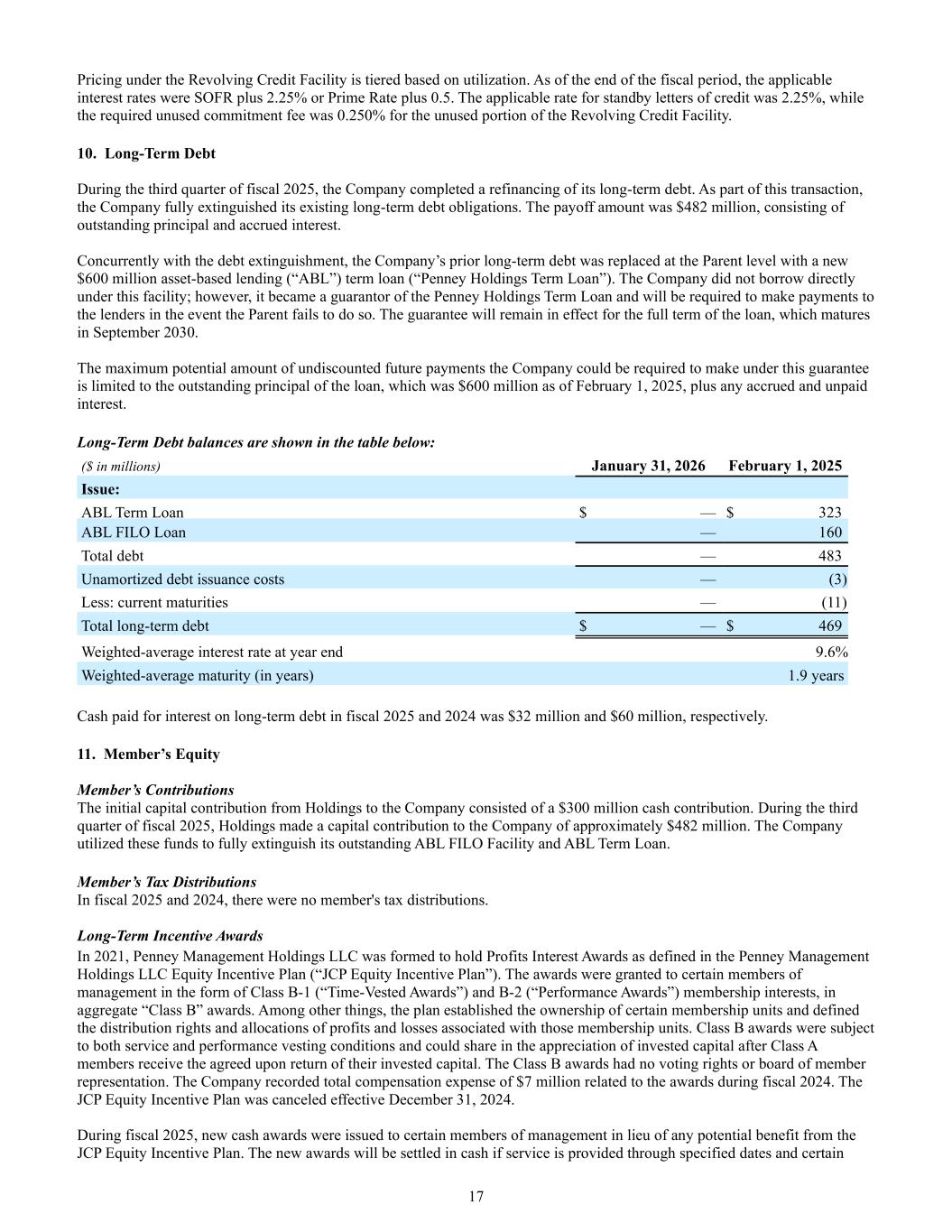
17 Pricing under the Revolving Credit Facility is tiered based on utilization. As of the end of the fiscal period, the applicable interest rates were SOFR plus 2.25% or Prime Rate plus 0.5. The applicable rate for standby letters of credit was 2.25%, while the required unused commitment fee was 0.250% for the unused portion of the Revolving Credit Facility. 10. Long-Term Debt During the third quarter of fiscal 2025, the Company completed a refinancing of its long‑term debt. As part of this transaction, the Company fully extinguished its existing long-term debt obligations. The payoff amount was $482 million, consisting of outstanding principal and accrued interest. Concurrently with the debt extinguishment, the Company’s prior long-term debt was replaced at the Parent level with a new $600 million asset-based lending (“ABL”) term loan (“Penney Holdings Term Loan”). The Company did not borrow directly under this facility; however, it became a guarantor of the Penney Holdings Term Loan and will be required to make payments to the lenders in the event the Parent fails to do so. The guarantee will remain in effect for the full term of the loan, which matures in September 2030. The maximum potential amount of undiscounted future payments the Company could be required to make under this guarantee is limited to the outstanding principal of the loan, which was $600 million as of February 1, 2025, plus any accrued and unpaid interest. Long-Term Debt balances are shown in the table below: ($ in millions) January 31, 2026 February 1, 2025 Issue: ABL Term Loan $ — $ 323 ABL FILO Loan — 160 Total debt — 483 Unamortized debt issuance costs — (3) Less: current maturities — (11) Total long-term debt $ — $ 469 Weighted-average interest rate at year end 9.6% Weighted-average maturity (in years) 1.9 years Cash paid for interest on long-term debt in fiscal 2025 and 2024 was $32 million and $60 million, respectively. 11. Member’s Equity Member’s Contributions The initial capital contribution from Holdings to the Company consisted of a $300 million cash contribution. During the third quarter of fiscal 2025, Holdings made a capital contribution to the Company of approximately $482 million. The Company utilized these funds to fully extinguish its outstanding ABL FILO Facility and ABL Term Loan. Member’s Tax Distributions In fiscal 2025 and 2024, there were no member's tax distributions. Long-Term Incentive Awards In 2021, Penney Management Holdings LLC was formed to hold Profits Interest Awards as defined in the Penney Management Holdings LLC Equity Incentive Plan (“JCP Equity Incentive Plan”). The awards were granted to certain members of management in the form of Class B-1 (“Time-Vested Awards”) and B-2 (“Performance Awards”) membership interests, in aggregate “Class B” awards. Among other things, the plan established the ownership of certain membership units and defined the distribution rights and allocations of profits and losses associated with those membership units. Class B awards were subject to both service and performance vesting conditions and could share in the appreciation of invested capital after Class A members receive the agreed upon return of their invested capital. The Class B awards had no voting rights or board of member representation. The Company recorded total compensation expense of $7 million related to the awards during fiscal 2024. The JCP Equity Incentive Plan was canceled effective December 31, 2024. During fiscal 2025, new cash awards were issued to certain members of management in lieu of any potential benefit from the JCP Equity Incentive Plan. The new awards will be settled in cash if service is provided through specified dates and certain
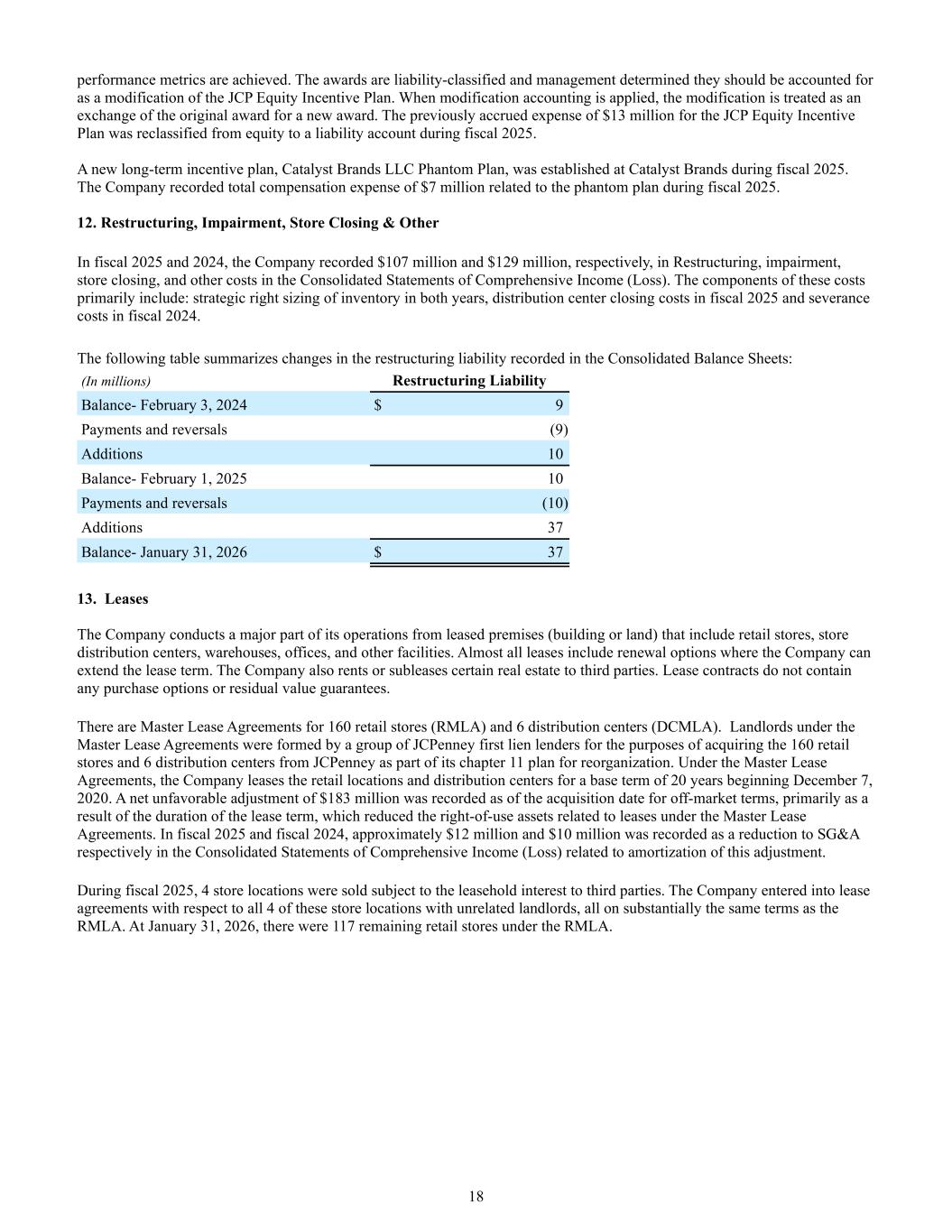
18 performance metrics are achieved. The awards are liability-classified and management determined they should be accounted for as a modification of the JCP Equity Incentive Plan. When modification accounting is applied, the modification is treated as an exchange of the original award for a new award. The previously accrued expense of $13 million for the JCP Equity Incentive Plan was reclassified from equity to a liability account during fiscal 2025. A new long-term incentive plan, Catalyst Brands LLC Phantom Plan, was established at Catalyst Brands during fiscal 2025. The Company recorded total compensation expense of $7 million related to the phantom plan during fiscal 2025. 12. Restructuring, Impairment, Store Closing & Other In fiscal 2025 and 2024, the Company recorded $107 million and $129 million, respectively, in Restructuring, impairment, store closing, and other costs in the Consolidated Statements of Comprehensive Income (Loss). The components of these costs primarily include: strategic right sizing of inventory in both years, distribution center closing costs in fiscal 2025 and severance costs in fiscal 2024. The following table summarizes changes in the restructuring liability recorded in the Consolidated Balance Sheets: (In millions) Restructuring Liability Balance- February 3, 2024 $ 9 Payments and reversals (9) Additions 10 Balance- February 1, 2025 10 Payments and reversals (10) Additions 37 Balance- January 31, 2026 $ 37 13. Leases The Company conducts a major part of its operations from leased premises (building or land) that include retail stores, store distribution centers, warehouses, offices, and other facilities. Almost all leases include renewal options where the Company can extend the lease term. The Company also rents or subleases certain real estate to third parties. Lease contracts do not contain any purchase options or residual value guarantees. There are Master Lease Agreements for 160 retail stores (RMLA) and 6 distribution centers (DCMLA). Landlords under the Master Lease Agreements were formed by a group of JCPenney first lien lenders for the purposes of acquiring the 160 retail stores and 6 distribution centers from JCPenney as part of its chapter 11 plan for reorganization. Under the Master Lease Agreements, the Company leases the retail locations and distribution centers for a base term of 20 years beginning December 7, 2020. A net unfavorable adjustment of $183 million was recorded as of the acquisition date for off-market terms, primarily as a result of the duration of the lease term, which reduced the right-of-use assets related to leases under the Master Lease Agreements. In fiscal 2025 and fiscal 2024, approximately $12 million and $10 million was recorded as a reduction to SG&A respectively in the Consolidated Statements of Comprehensive Income (Loss) related to amortization of this adjustment. During fiscal 2025, 4 store locations were sold subject to the leasehold interest to third parties. The Company entered into lease agreements with respect to all 4 of these store locations with unrelated landlords, all on substantially the same terms as the RMLA. At January 31, 2026, there were 117 remaining retail stores under the RMLA.
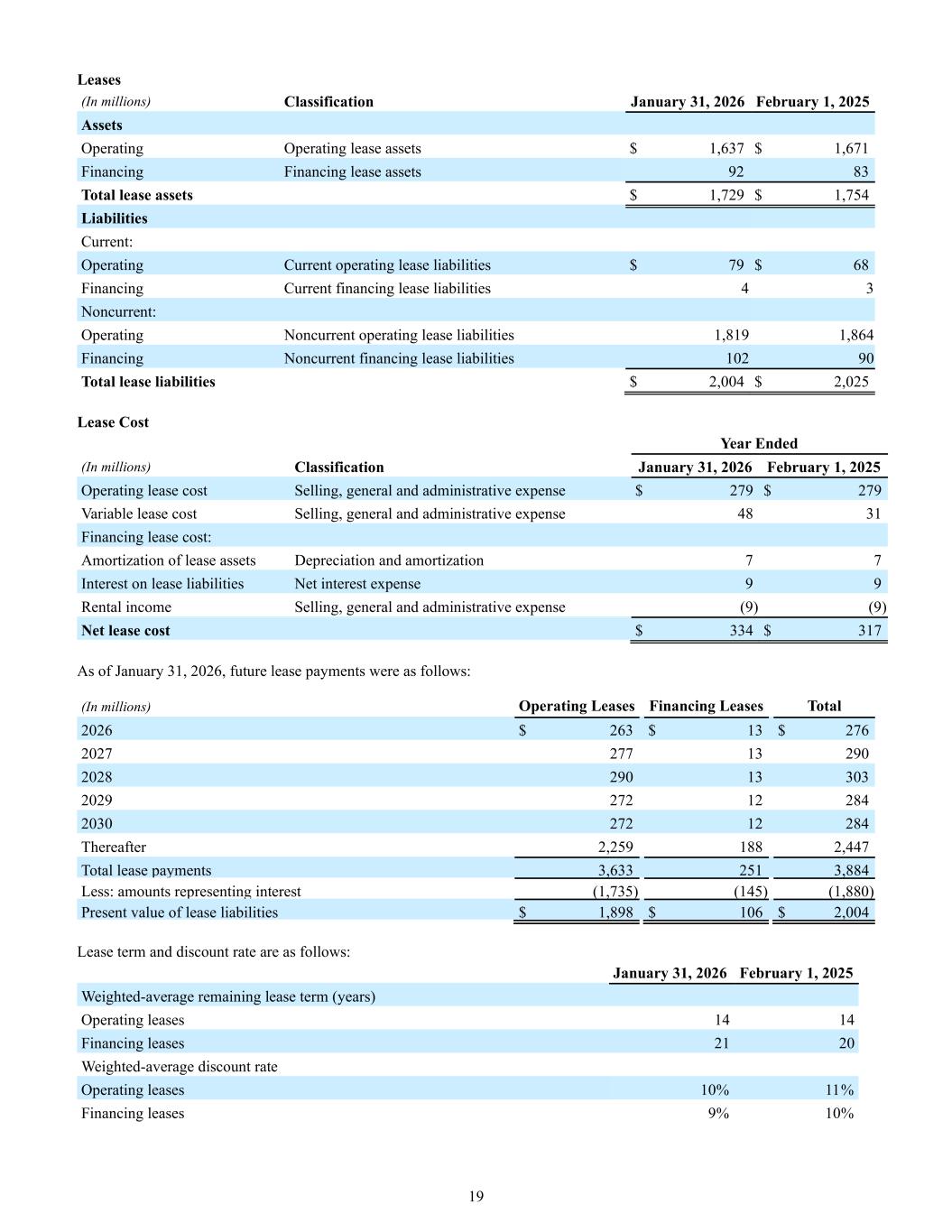
19 Leases (In millions) Classification January 31, 2026 February 1, 2025 Assets Operating Operating lease assets $ 1,637 $ 1,671 Financing Financing lease assets 92 83 Total lease assets $ 1,729 $ 1,754 Liabilities Current: Operating Current operating lease liabilities $ 79 $ 68 Financing Current financing lease liabilities 4 3 Noncurrent: Operating Noncurrent operating lease liabilities 1,819 1,864 Financing Noncurrent financing lease liabilities 102 90 Total lease liabilities $ 2,004 $ 2,025 Lease Cost Year Ended (In millions) Classification January 31, 2026 February 1, 2025 Operating lease cost Selling, general and administrative expense $ 279 $ 279 Variable lease cost Selling, general and administrative expense 48 31 Financing lease cost: Amortization of lease assets Depreciation and amortization 7 7 Interest on lease liabilities Net interest expense 9 9 Rental income Selling, general and administrative expense (9) (9) Net lease cost $ 334 $ 317 As of January 31, 2026, future lease payments were as follows: (In millions) Operating Leases Financing Leases Total 2026 $ 263 $ 13 $ 276 2027 277 13 290 2028 290 13 303 2029 272 12 284 2030 272 12 284 Thereafter 2,259 188 2,447 Total lease payments 3,633 251 3,884 Less: amounts representing interest (1,735) (145) (1,880) Present value of lease liabilities $ 1,898 $ 106 $ 2,004 Lease term and discount rate are as follows: January 31, 2026 February 1, 2025 Weighted-average remaining lease term (years) Operating leases 14 14 Financing leases 21 20 Weighted-average discount rate Operating leases 10 % 11 % Financing leases 9 % 10 %
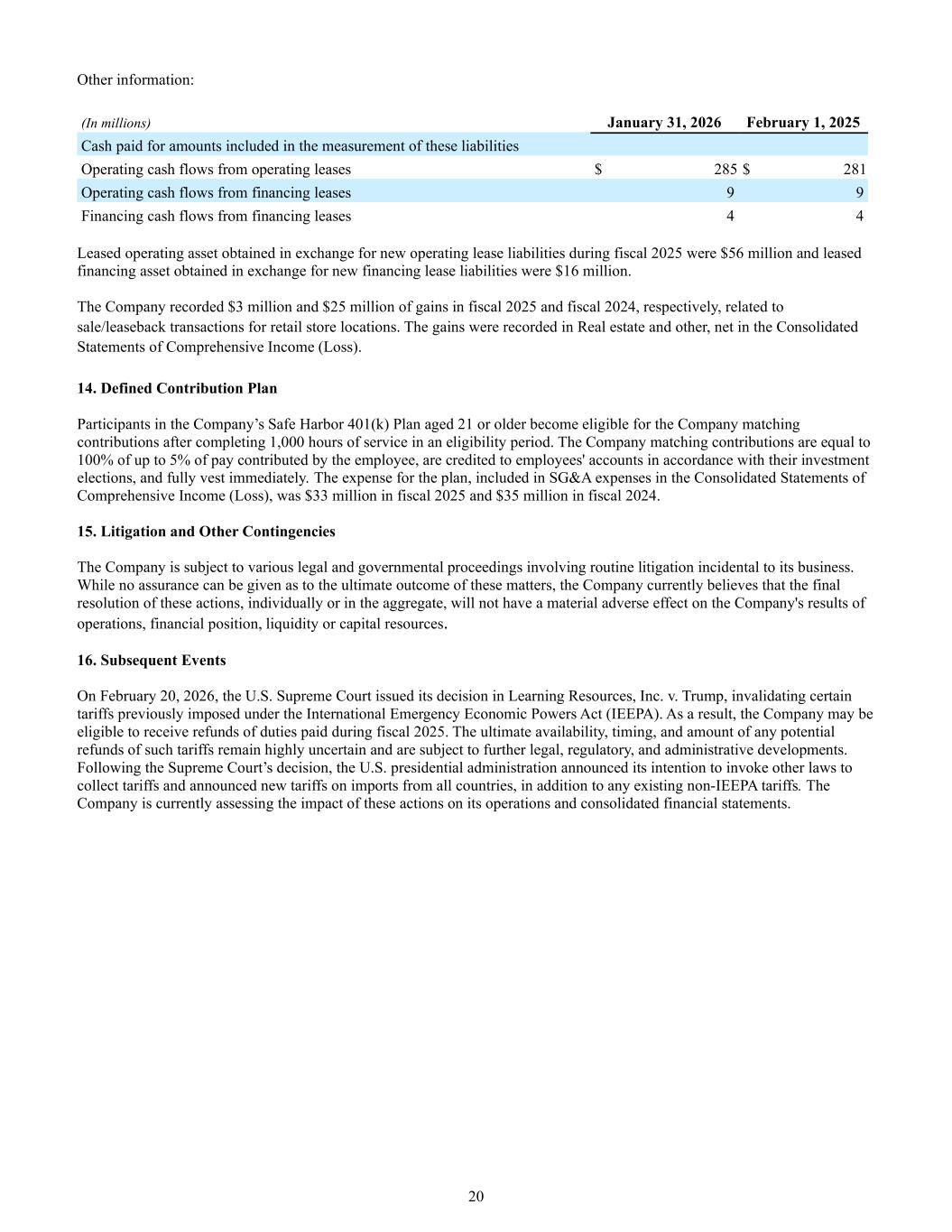
20 Other information: (In millions) January 31, 2026 February 1, 2025 Cash paid for amounts included in the measurement of these liabilities Operating cash flows from operating leases $ 285 $ 281 Operating cash flows from financing leases 9 9 Financing cash flows from financing leases 4 4 Leased operating asset obtained in exchange for new operating lease liabilities during fiscal 2025 were $56 million and leased financing asset obtained in exchange for new financing lease liabilities were $16 million. The Company recorded $3 million and $25 million of gains in fiscal 2025 and fiscal 2024, respectively, related to sale/leaseback transactions for retail store locations. The gains were recorded in Real estate and other, net in the Consolidated Statements of Comprehensive Income (Loss). 14. Defined Contribution Plan Participants in the Company’s Safe Harbor 401(k) Plan aged 21 or older become eligible for the Company matching contributions after completing 1,000 hours of service in an eligibility period. The Company matching contributions are equal to 100% of up to 5% of pay contributed by the employee, are credited to employees' accounts in accordance with their investment elections, and fully vest immediately. The expense for the plan, included in SG&A expenses in the Consolidated Statements of Comprehensive Income (Loss), was $33 million in fiscal 2025 and $35 million in fiscal 2024. 15. Litigation and Other Contingencies The Company is subject to various legal and governmental proceedings involving routine litigation incidental to its business. While no assurance can be given as to the ultimate outcome of these matters, the Company currently believes that the final resolution of these actions, individually or in the aggregate, will not have a material adverse effect on the Company's results of operations, financial position, liquidity or capital resources. 16. Subsequent Events On February 20, 2026, the U.S. Supreme Court issued its decision in Learning Resources, Inc. v. Trump, invalidating certain tariffs previously imposed under the International Emergency Economic Powers Act (IEEPA). As a result, the Company may be eligible to receive refunds of duties paid during fiscal 2025. The ultimate availability, timing, and amount of any potential refunds of such tariffs remain highly uncertain and are subject to further legal, regulatory, and administrative developments. Following the Supreme Court’s decision, the U.S. presidential administration announced its intention to invoke other laws to collect tariffs and announced new tariffs on imports from all countries, in addition to any existing non-IEEPA tariffs. The Company is currently assessing the impact of these actions on its operations and consolidated financial statements.